

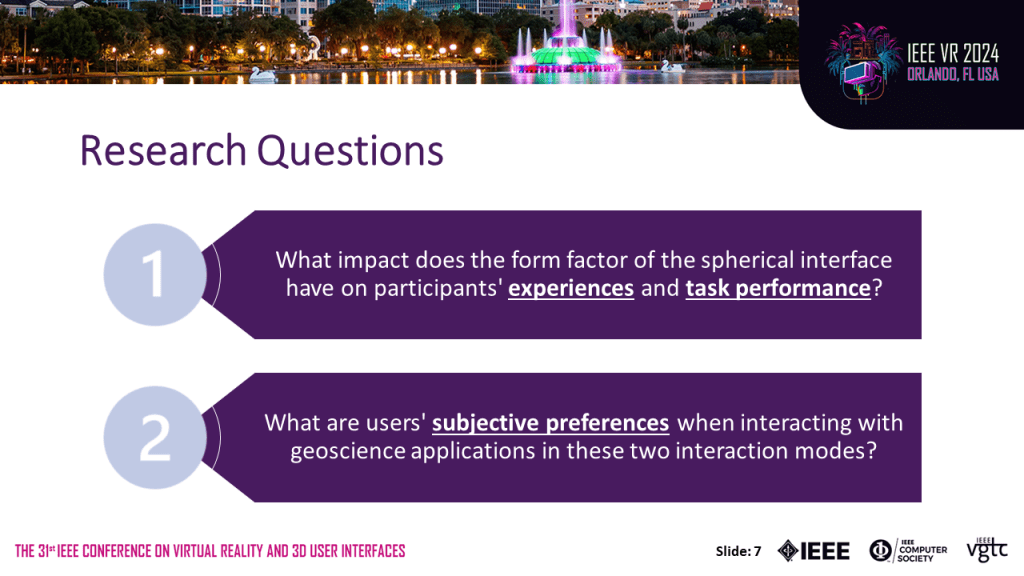
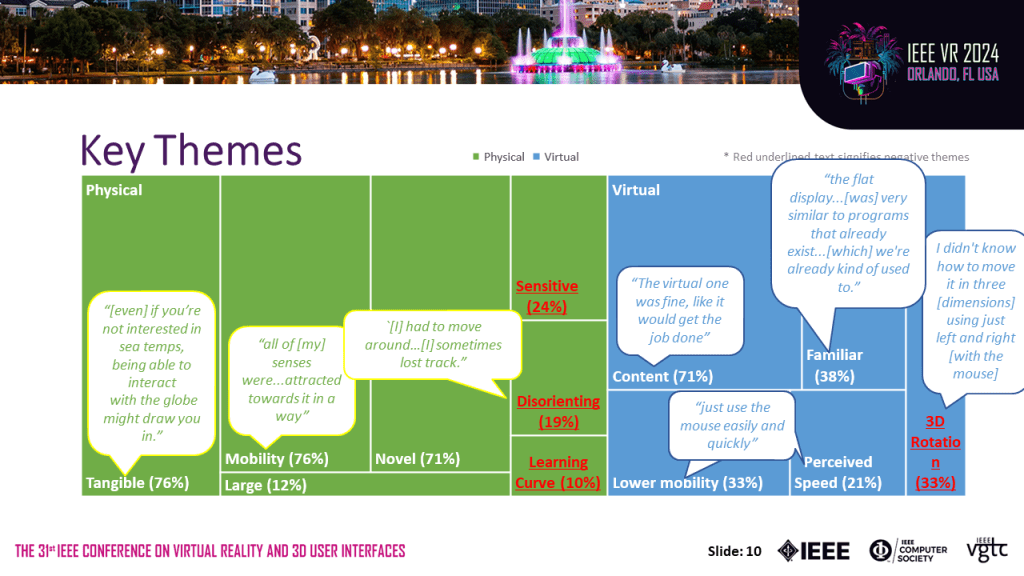
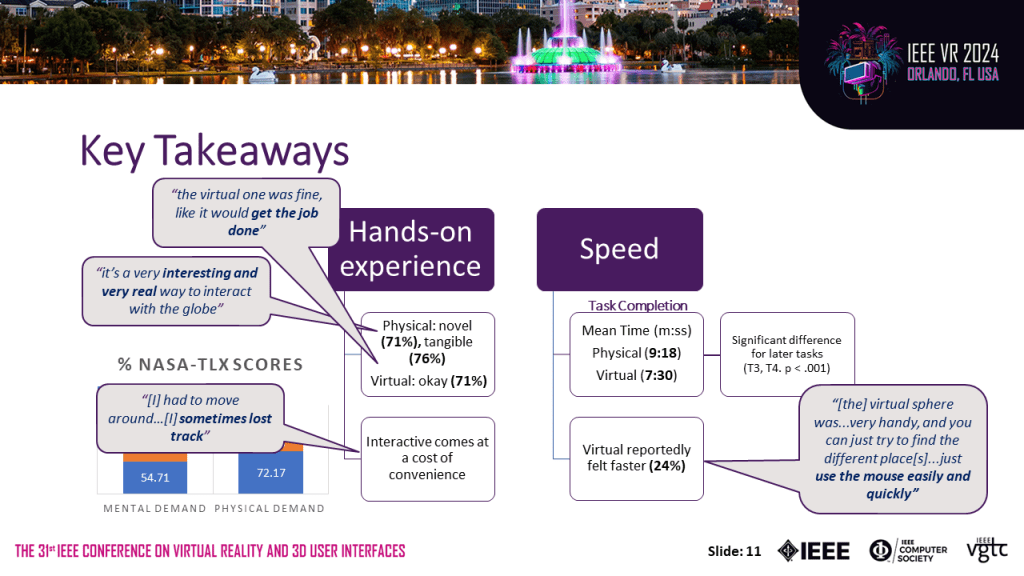
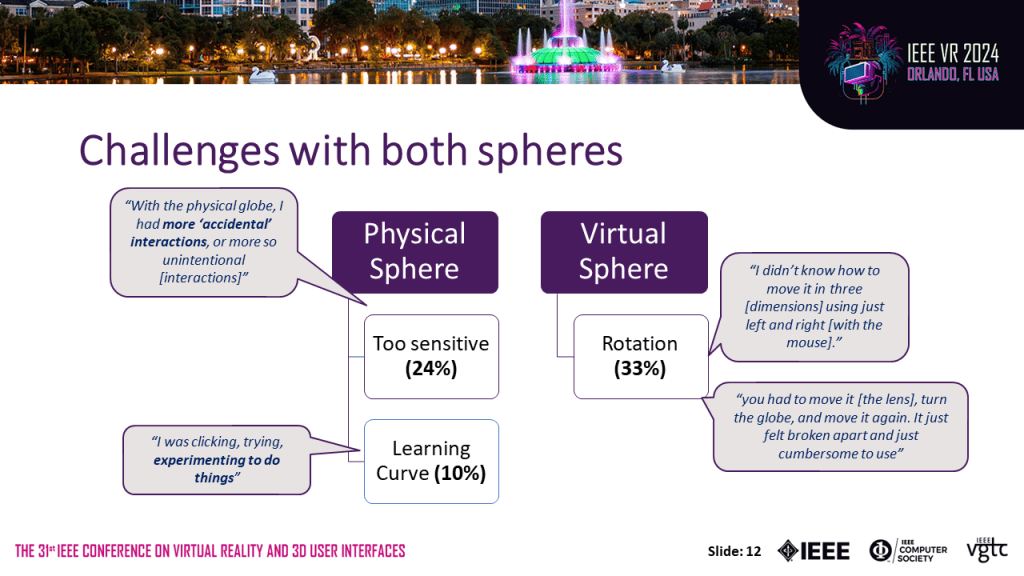
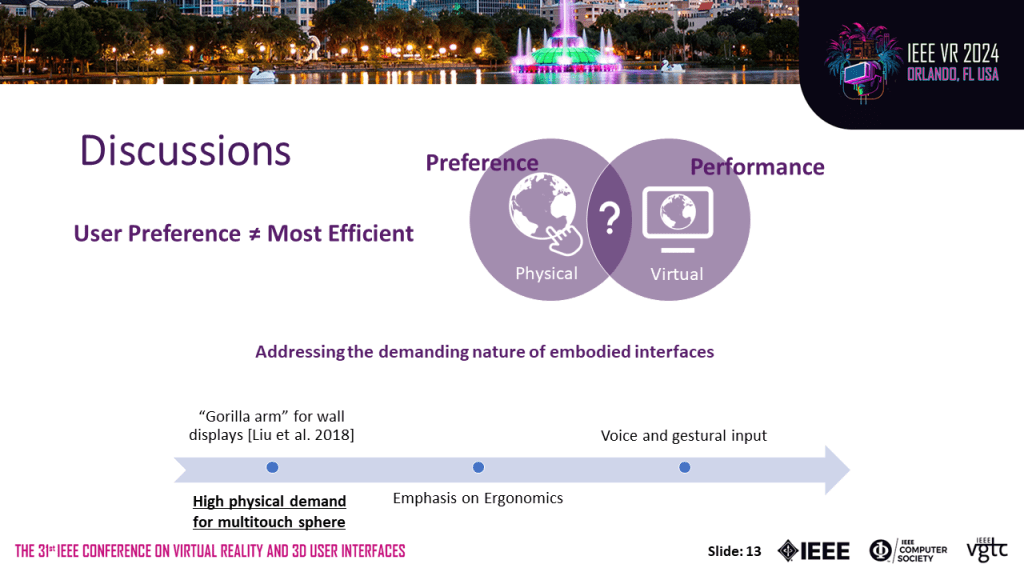
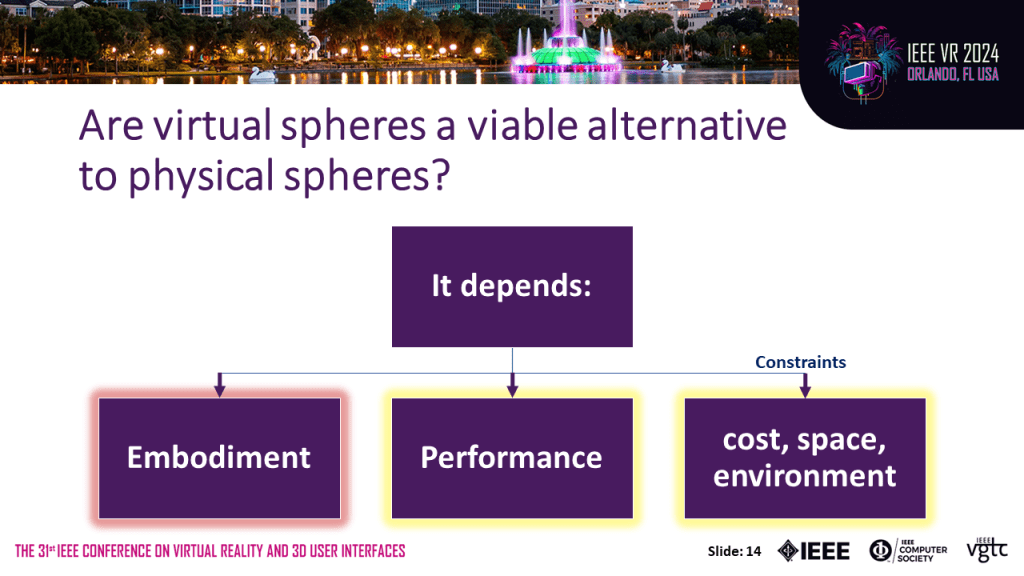
I presented a conference paper titled “A comparative Usability Study of Physical Multi-touch versus Virtual Desktop-Based Spherical Interfaces” as a part of the UF TIDESS project at IEEE VR 2024, held at the Walt Disney Contemporary Resort in Orlando, FL. In our research, we conducted a comparative usability study of physical spheres and virtual spheres (i.e., Google Earth) for geoscience data interaction. Our findings revealed that physical spheres provide a sense of embodiment that is unmatched. However, the virtual spheres might serve as a “good enough” alternative, especially when considering space and cost constraints.
The slides from the presentation are shown below. You can find the full paper here. I would also like to thank the PIs for the opportunity and their mentorship, as well as the student team for their contributions.




Audience Questions
- Did you consider using a touchpad to navigate the virtual sphere in addition to a mouse? Yes, we did. We used a mouse because it is more precise to navigate and more affordable. One goal of this study is to look into more affordable alternatives to physical spheres for schools for earth science education. Considering these schools operate with tight budgets, the cost of these things add up at scale.
- How is the maskviewer lens moved, does it rotate the sphere? Any navigation done within the boundary of the mask viewer moves only the maskviewer lens, the sphere is only rotated with it when the maskviewer approaches the boundary of the displayed area of the sphere.
- Have you considered implementing the spherical display with augmented reality? Yes, the IEEE VR community has extensively explored this area in virtual reality. For example, in slide 6. As for augmented reality, Dr. Soni is exploring this area in future work.
 Oluwatomisin Obajemu